Forex trading or stock investing which is better for a beginner and why
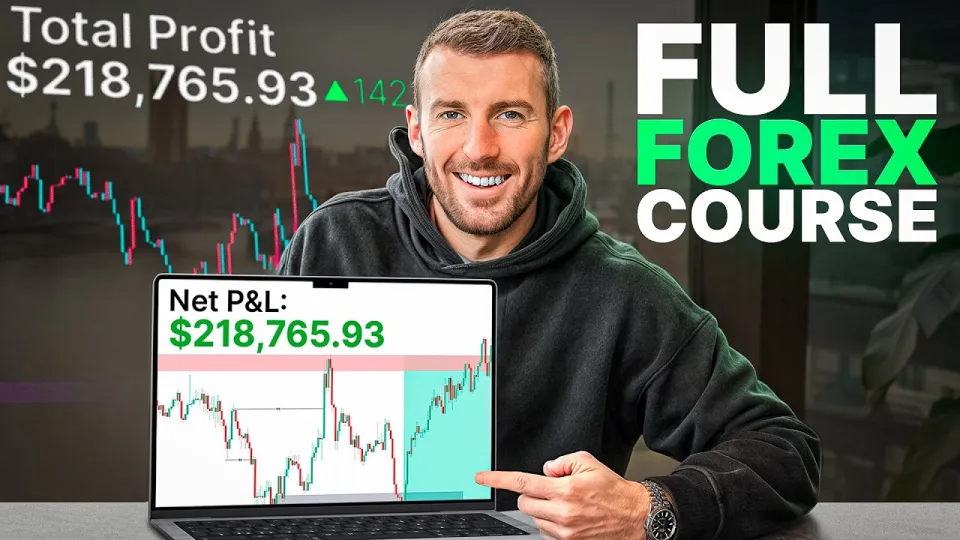
Video: Beginners Guide To Forex Trading In 2026 (+3 hours)
You can order the same kind of articles for your own video to boost it on YouTube and Google. Just message the Telegram bot @sat_sit_bot. It writes articles around your video, embeds the video and publishes them on popular niche websites (no ads). Try it free: 50 articles on us.
· based on the channel Matt Donlevey - Photon Trading
Forex is a better starting point than stock investing for a beginner who wants to learn how price actually moves, because the currency market is the cleanest place to study order flow, liquidity and auction dynamics without drowning in thousands of individual company stories. Matt Donlevey, the trader behind the channel Matt Donlevey - Photon Trading, built his three-hour beginner guide around exactly that idea: understand the underlying mechanics first, then build a strategy on top of them. The free Photon Trading course and cheatsheets that accompany the video are available through the Photon Trading free training page.
The logic is simple. A currency pair is a single instrument with one price, one order book and one set of participants reacting to the same macro drivers. A stock portfolio forces a beginner to juggle earnings reports, sector rotation and company-specific news before they have even learned what a bid-ask spread is. Forex compresses the learning curve: fewer variables, more repetition, faster feedback.
What forex trading actually is and who is on the other side
Forex is the exchange of one currency for another in an over-the-counter market, which means there is no central exchange and no single tape — prices are quoted by a network of banks, brokers and liquidity providers. The most traded pair, EUR/USD, typically carries the tightest spread, while exotic pairs can cost several times more per round trip. That structural difference alone shapes which instruments a beginner should touch.
The counterparties matter as much as the instrument. When you buy a pair, someone is selling it: a bank hedging exposure, a corporate treasury converting revenue, an algorithm arbitraging a cross-rate, or another retail trader on the opposite side of the screen. Understanding who needs to transact and why is the foundation of every serious approach to forex trading, and it is where the Photon material starts rather than with candlestick patterns.
Why technical analysis alone gets traders nowhere
Technical analysis has a poor reputation because geometric shapes do not explain why price moves — they only describe what it already did. A head-and-shoulders pattern has no causal mechanism behind it; a cluster of resting stop orders does. The distinction matters because strategies built on description tend to break the moment market conditions shift, while strategies built on mechanics degrade more slowly and more predictably.
This is the core argument of the guide: you must understand the true underlying market dynamics before a chart pattern means anything. Once you know that price is searching for liquidity, a level on a chart stops being a line and becomes a place where orders are likely sitting.
Market microstructure, order books and auction market theory
Market microstructure is the study of how orders become trades, and it starts with three numbers every beginner should be able to define without hesitation:
- Bid — the highest price a buyer is currently willing to pay.
- Ask — the lowest price a seller is currently willing to accept.
- Spread — the gap between them, which is the immediate cost of entering a trade.
From there the guide moves into the order book: the stacked resting orders on both sides that show where liquidity is thin and where it is dense. Auction market theory adds the interpretation — price moves up and down as the market searches for areas where buyers and sellers agree on value, and it accelerates when one side runs out of orders. Order flow is the record of which side is actually being aggressive. Read together, these three concepts explain most of what a candlestick chart is trying to tell you, and they are the reason the video spends over an hour on mechanics before touching entries.
The Photon strategy: structure, premium and discount, liquidity
The Photon strategy is a systematic framework built on market structure rather than on indicators. Its components stack in a fixed order, and skipping a step usually produces a strategy that looks fine in hindsight and fails live.
- Market structure — mapping the sequence of highs and lows that defines direction, including the three distinct types of structure the guide separates.
- Premium and discount — dividing a range in half so you buy in the cheaper half and sell in the expensive half instead of chasing price at the extremes.
- Multi-timeframe analysis — aligning a higher-timeframe bias with a lower-timeframe entry so the two are not fighting each other.
- Supply and demand — marking zones where aggressive orders previously overwhelmed the opposite side.
- Liquidity concepts — identifying where stops and pending orders cluster, because those pools are what price tends to reach for.
Entries and trade management come last, after the map exists. That ordering is deliberate: a good entry inside a bad map is still a bad trade.
Money management, trade plans and the mistakes that end accounts
Money management is the part of forex trading that decides whether you survive long enough to become consistent. The guide treats it as a fixed rule set written down in advance — risk per trade, maximum daily loss, maximum number of open positions — rather than a feeling recalibrated after every loss. Three mistakes come up repeatedly: risking too much on a single idea, moving stops to avoid taking a loss, and trading without a written plan.
A trade plan converts intent into checkboxes: which pairs, which sessions, which setup, what invalidates the idea, where the stop goes, where the target sits. Backtesting then tests whether the plan has an edge at all — a few hundred historical setups, logged honestly, tell you more than a month of live guessing. Choosing a broker and understanding trading costs belong in the same document, because spread and commission determine whether a marginal edge survives at all. Execution and journaling close the loop: every trade gets recorded with the reason for entry, the outcome and the emotional state, so patterns in your own behaviour become visible.
Common questions beginners ask before their first trade
Beginners tend to arrive with the same handful of doubts, and most of them are about sequencing rather than secrets. The most frequent is how much can be made — the honest answer is that returns depend entirely on risk per trade and the quality of the edge, and that any figure quoted without those two variables is marketing. A trader risking 1% per trade with a modest win rate compounds slowly; someone chasing large monthly percentages is usually sizing positions in a way that guarantees a blow-up.
Another recurring question is whether to trade other people's money. Prop firm funding and managed accounts exist, but they amplify whatever the underlying strategy already does — a losing approach with more capital simply loses faster. The same logic applies to psychology: traders who have not yet built and tested an edge often reach for mindset work first, when the real problem is that there is no defined strategy to be disciplined about. Master the mechanics, prove the edge in backtesting, and the psychological pressure becomes manageable rather than overwhelming.
A third theme is the sheer volume of material. A three-hour guide can feel dense, and non-native speakers in particular report struggling with pace. The practical fix is to watch in segments, take notes on one concept at a time and immediately test it on a chart before moving on — passive viewing produces the illusion of progress without any of the skill.
Useful links
- Free Photon Trading course and cheatsheets: https://www.photontradingfx.com/free-training?el=beginnersguide&htrafficsource=YT
- Photon Trading mentorship: https://www.photontradingfx.com?el=beginnersguide&htrafficsource=yt
- Free Telegram channel with analysis and trade recaps: https://t.me/photontrading
- Instagram: https://www.instagram.com/photontrading/
Final thoughts on learning forex properly
Forex rewards traders who understand mechanics before they touch a chart, and it punishes those who collect patterns and hope. The sequence that works is unglamorous: microstructure and order flow first, then structure and liquidity, then a written plan, then backtesting, then live execution with strict risk limits. Matt Donlevey - Photon Trading lays that sequence out in one continuous path instead of scattering it across dozens of disconnected tutorials, which is the main reason the guide is worth working through rather than skimming. If you want the condensed version to keep beside your charts, start with the free Photon Trading course and cheatsheets and build your trade plan around it.
Key takeaways
- Forex is an over-the-counter market of currency pairs where price moves because of order flow, not because of chart shapes.
- Photon Trading's three-hour beginner guide covers microstructure, auction market theory, order flow, the Photon strategy, money management and journaling.
- The free Photon Trading course and cheatsheets are available at photontradingfx.com/free-training.
- A trading plan, backtesting and a journal are treated as core infrastructure, not optional extras.
- Trading psychology is presented as a second-stage problem that follows a proven edge, not a substitute for one.
Questions & answers
Is forex trading suitable for a complete beginner?
Yes, provided the beginner treats it as a skill to be studied rather than a shortcut to income. Currency pairs offer a single, clean instrument with tight spreads on majors, which makes the mechanics of price movement easier to learn than in a market of thousands of individual stocks. The first weeks should go into microstructure, order flow and a written trade plan, not into live position sizing.
How much money can a forex trader realistically make?
There is no fixed number, because results depend on risk per trade, win rate and the number of setups taken. A trader risking a small fixed percentage per trade with a tested edge should expect modest, compounding returns rather than the large monthly percentages advertised online. Anyone quoting a figure without stating risk per trade is selling something.
Do I need technical analysis to trade forex?
You need to read price, but chart patterns alone explain very little. Technical analysis describes what price has done; market microstructure, order flow and auction theory explain why it moves. Use structure, premium and discount zones and liquidity levels as a map, and treat classical patterns as secondary context.
Should I focus on trading psychology or on strategy first?
Build and test the strategy first. Psychology work matters most once you have a proven edge and need to execute it consistently under pressure. Without a tested edge, discipline has nothing to enforce, and mindset content becomes a way of avoiding the harder analytical work.
Source: Beginners Guide To Forex Trading In 2026 (+3 hours) · Markdown version